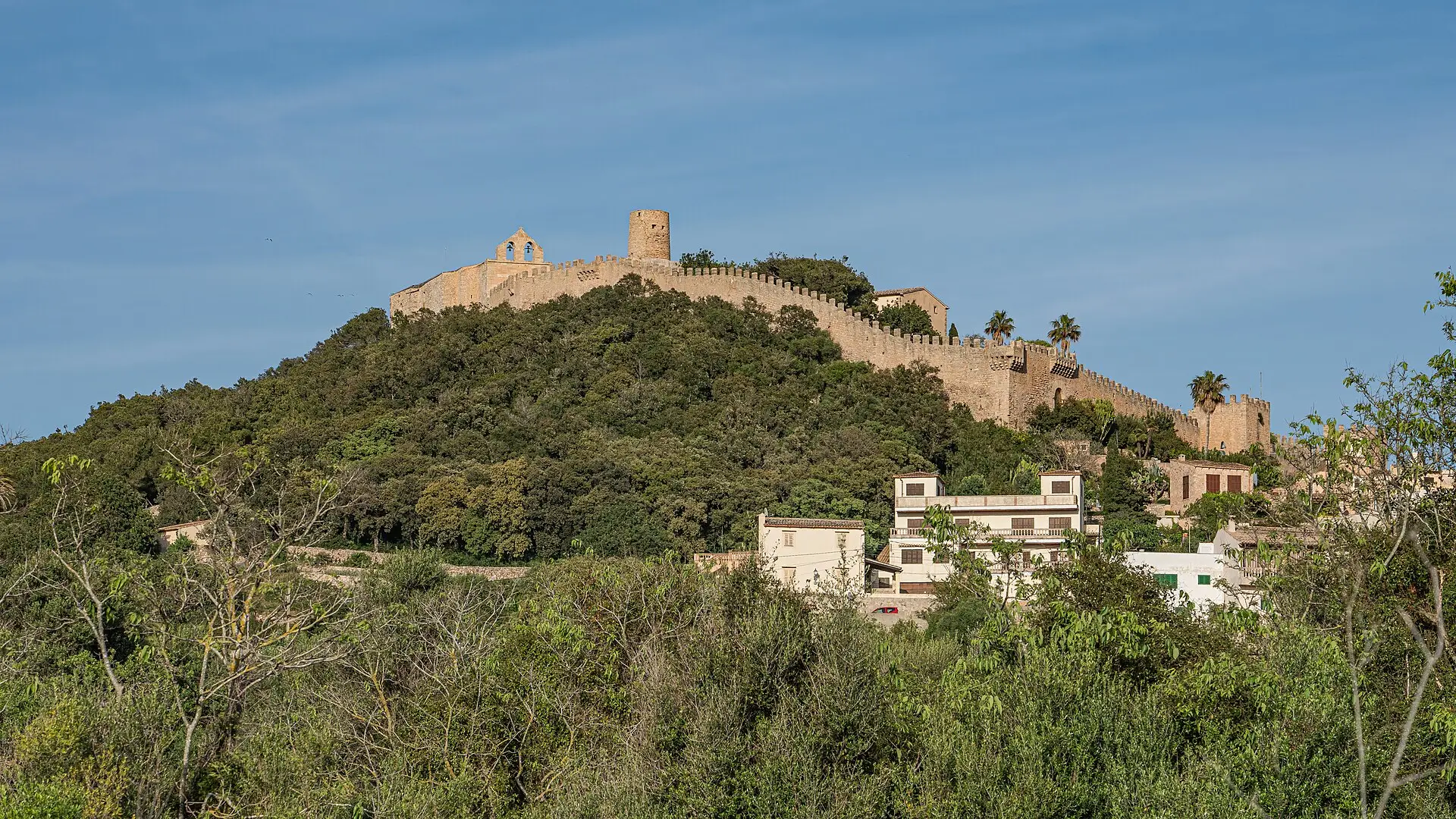
The main town of the municipality that also includes Cala Ratjada, Canyamel, Font de sa Cala and Cala Mesquida. Capdepera itself is not on the sea — which is exactly what makes it the other half of the same decision.
Source: INE, Padrón Continuo · 2026-08-22
Search for “Capdepera” and you are often really searching for the whole municipality — it stretches from Cala Mesquida in the north to Canyamel in the south and includes Cala Ratjada. This page is about the town itself: the small town beneath the castle, three kilometres inland from the coast.
The Castell de Capdepera is not a backdrop but the reason the town exists: a fortified compound from the 14th century, within whose walls the population of the area lived for centuries. Today’s old centre is its direct descendant — it grew down the hillside, and the lanes below the castle remain its oldest part.
For everyday life this means Capdepera is a lived-in town with a church, squares and a weekly market on Wednesdays — not a coastal resort that shuts its shops in winter.
The old centre is made up of townhouses, many of natural stone, some in the same family for decades. This is where you buy a village house with substance — often in need of renovation, but with a build quality and a position that cannot be reproduced. From the upper lanes you see the castle, the countryside, or both.
The edges of town are younger and more practical: family homes and semi-detached houses with gardens, built for living rather than for the postcard.
The countryside is finca country. Between Capdepera, Artà and Canyamel lie country houses on their own land, and on the road towards the coast sits Capdepera’s golf course. Our current exclusive listing comes from exactly this countryside: a restored finca by the golf course.
Capdepera and Cala Ratjada are three kilometres apart, but in character they are further. On the coast you buy sea views, coves and the bustle of a resort. In Capdepera you buy a town that is still one in January — and you pay for it not in money but in the short drive to the water.
If you are weighing one against the other, compare them in person on a single afternoon: first the market in Capdepera, then the harbour of Cala Ratjada. The difference explains itself.
The municipality of Capdepera had 12,081 registered residents in 2022, against 11,858 in 2011 — plus two percent in eleven years, effectively standstill. The coastal villages of the municipality cannot grow because protected land hems them in, and the main town grows only slowly into its surroundings.
The registered foreign population stood at 3,770 in 2011, fell to 2,247 by 2017 and, at 2,691 today, is still around 29 percent below the starting point — the trace of the financial crisis, not yet made up.
Both series come from the Padrón Continuo of the Spanish statistics office and count only people registered as residents. Second homes do not appear in them — and second homes are a large part of what is bought here. The figures describe the town, not the market.
Our office is in Cala Ratjada, three kilometres away — Capdepera is our neighbourhood, not our catchment area. Townhouses in the centre, houses on the edge, fincas in the countryside: we know the differences between the lanes from driving there, not from a portal.
New ETV licences are not currently being issued on Mallorca. What matters is therefore not the location but whether the individual property carries an existing one. Every property of ours states it in the key facts.
Guide to the holiday rental licenceBuying on Mallorca rarely takes weeks. Tell us what you are looking for — we get in touch when something fitting comes up, and no more often than that.
Population figures are official, from the INE. Market observations are our own and are not statistics.