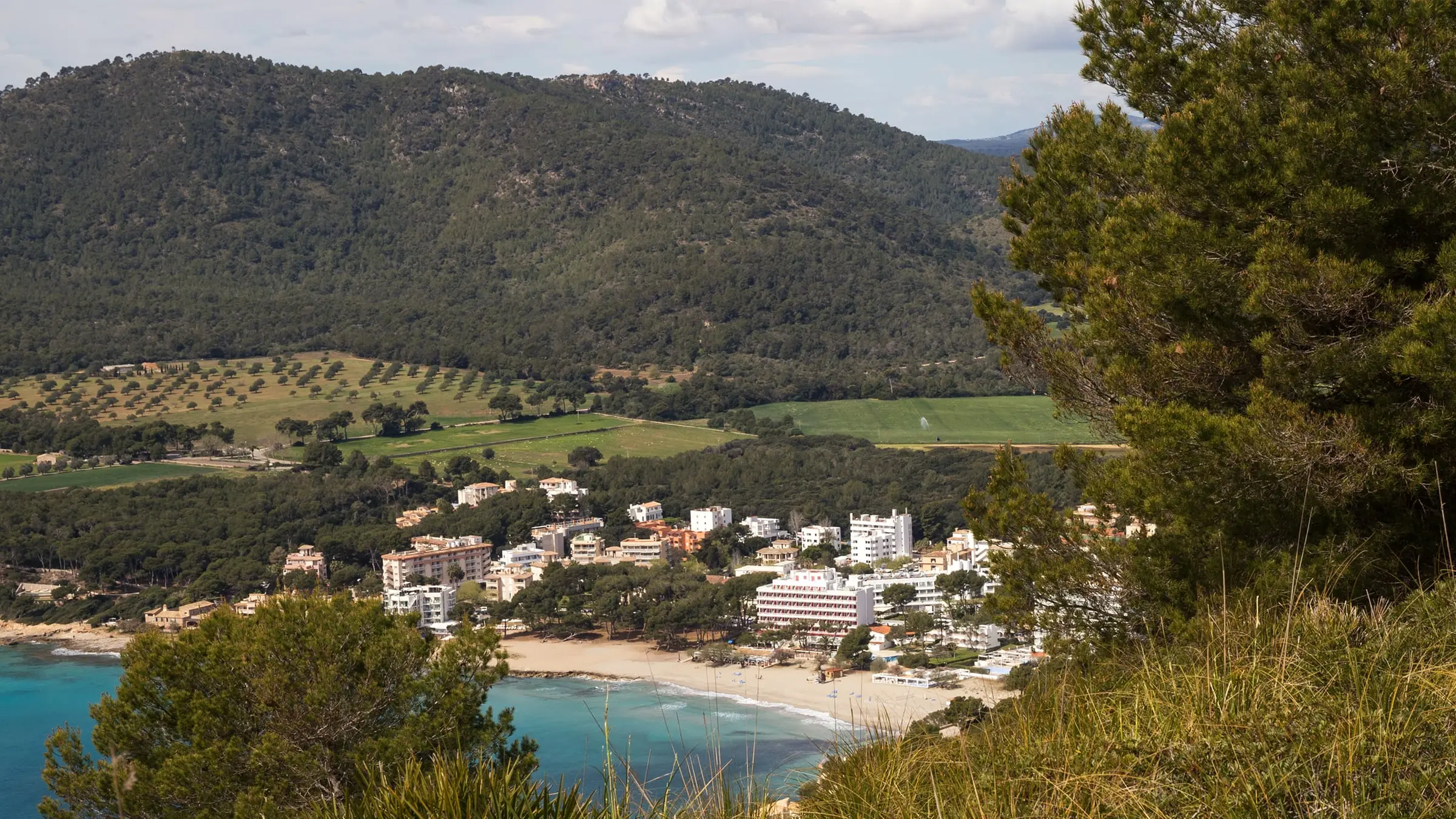
A wide beach at the mouth of a valley, with a golf course and a thirteenth-century watchtower behind it. Only a small part of it is built on — and that is the point.
Source: INE, Padrón Continuo · 2026-08-04
Canyamel lies on the east coast, municipality of Capdepera — the same as Cala Ratjada, but at the other end, roughly halfway between Cala Ratjada and Cala Millor. The settlement sits where a valley from the interior runs out to the coast.
Two kilometres inland stands the Torre de Canyamel, a Gothic watchtower of the thirteenth century: square in plan, 23 metres high, walls a metre thick at ground level, three floors linked by winding stairs. In this form it is the only one of its kind on Mallorca. It was built to watch the coast and to shelter the people of the fertile valley from corsair raids.
It was originally the Torre d’en Montsó. It took its present name in the second half of the fifteenth century, when sugar cane was grown here — canya mel, honey cane. The place is named after a plant that has not grown here for five hundred years. Since 2009 the tower has been open to the public as a museum.
Two kilometres in the other direction, in the cliff face, are the Coves d’Artà — one of the island’s great stalactite caves, with an entrance high above the sea.
The beach is wide and shallow and counts among the better ones on the east coast. What defines the character of the place, though, is what lies behind it: the valley has stayed largely undeveloped. Farmland, pine slopes, the golf course — but no continuous building.
Canyamel therefore has no centre in the narrow sense. There are hotels, a few restaurants and housing near the beach, but no grown village core. If you need everyday infrastructure you drive to Capdepera or Artà, about twelve kilometres either way.
The difference between positions here is mainly one of coast versus valley.
Near the beach is the denser building: a short walk to the water, and the most activity in season.
By the golf course and on the slopes above are the more spacious plots. Canyamel Golf is an eighteen-hole course routed through Mediterranean pine with the mountains of Artà behind.
In the valley are individual fincas and country houses on large plots. Rural building law applies here, though — what is possible on a plot of suelo rústico depends on minimum sizes and protection categories, not on area alone.
The municipality of Capdepera had 12,081 registered inhabitants in 2022, against 11,858 in 2011. Over eleven years it has grown by 2 per cent.
The second series is the more interesting one. The registered foreign population stood at 3,770 in 2011 and today, at 2,691, is around 29 per cent below that. That is the mark of the financial crisis, and in Capdepera it has not been made up.
Both series come from the Spanish statistics office’s Padrón Continuo and record only people with a registered address. Second homes do not appear in them — and second homes are the greater part of what is bought on Mallorca. The figures describe the town, not the market. Read as a demand indicator, they mislead.
They are the same figures as for Cala Ratjada: both places lie in the municipality of Capdepera. The difference between them is not statistical but physical — Cala Ratjada is a grown harbour town, Canyamel a markedly smaller coastal settlement without a core of its own.
Canyamel is the quiet version of this stretch of coast. If you value the infrastructure of Cala Ratjada but do not want it on your doorstep, it is twelve kilometres away.
The place where most money is lost here is rural building law. On any property on rural land, establish before purchase what is actually authorised and what was merely built — the two diverge more often on Mallorca than buyers expect.
New ETV licences are not currently being issued on Mallorca. What matters is therefore not the location but whether the individual property carries an existing one. Every property of ours states it in the key facts.
Guide to the holiday rental licenceBuying on Mallorca rarely takes weeks. Tell us what you are looking for — we get in touch when something fitting comes up, and no more often than that.
Population figures are official, from the INE. Market observations are our own and are not statistics.