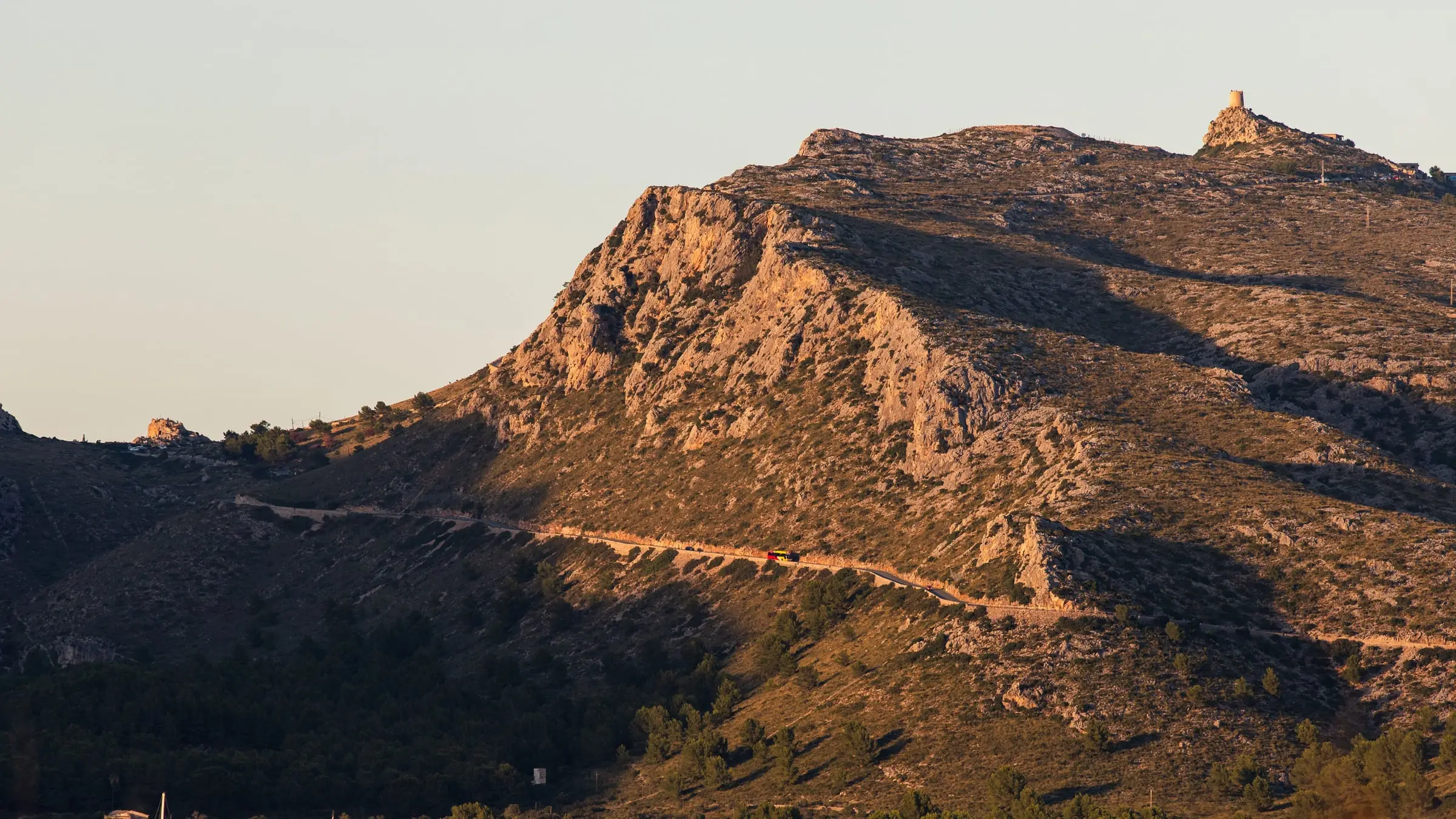
The most northerly town on Mallorca, its seafront shaded by the same pines for a hundred years. The Tramuntana ends here and the bay begins — and this is the one coastal municipality we checked that is still growing.
Source: INE, Padrón Continuo · 2026-08-04
Puerto Pollensa — Port de Pollença in Catalan — sits on the southern shore of the bay of the same name in northern Mallorca, where the Serra de Tramuntana runs out into the sea. It is the island’s most northerly town.
Six kilometres inland lies the town of Pollença. Both belong to the same municipality, but they are two different places with two different property markets: Pollença is a grown hillside town of limestone houses and the well-known Calvary steps, Puerto Pollensa a harbour and residential town on the water. Confusing the two is the most common mistake buyers make here.
Port de Pollença divides into seven areas: Pine Walk, Boquer, Central, Siller, Pinaret, Llenaire and Gotmar. They differ more than a map suggests.
The Pine Walk — officially Passeig Vora Mar — is the seafront promenade under old Aleppo pines and the best-known address in town. What sits here sits in the front line: apartments looking straight out over the bay with no road in between. It is also why British visitors have been coming since the 1920s.
Llenaire runs parallel behind the shoreline and is the area for larger villas with grounds within walking distance of the beach. Considerably quieter than the promenade, without giving it up.
Gotmar climbs the slope behind the harbour. Villas and apartments in mature gardens, many on inclines with views across the bay and the Tramuntana. If you want height and outlook rather than proximity to the sand, this is where to look.
Boquer lies on the north-eastern edge, where the Bóquer valley runs down to the coast between two ridges — a well-known walking route, and close by the remains of Bocchoris, a pre-Roman settlement and one of the oldest on the island.
Central, Siller and Pinaret make up the town centre, with the shortest walk to shops, school and harbour — the areas for year-round living.
To the north-east a 13.5-kilometre road runs out onto the Formentor peninsula, twelve kilometres long and three wide, the last spurs of the Tramuntana. Two kilometres north-west is Cala Sant Vicenç with its four small coves — Cala Barques, Cala Clara, Cala Molins and Cala Carbó — at the foot of the Cavall Bernat.
The bay of Pollença is shallow and sheltered. That makes it one of the island’s more dependable stretches of water for sailing and windsurfing in summer, and keeps the town milder in winter than its northerly position suggests.
The municipality of Pollença had 17,126 registered inhabitants in 2022, against 16,114 in 2011. Over eleven years it has grown by 6 per cent.
The second series is the striking one. The registered foreign population has risen from 3,534 to 4,003, up 13 per cent. Pollença is one of the few coastal municipalities on Mallorca to have pushed that figure back above its pre-crisis level — in most others it remains double digits below.
Both series come from the Spanish statistics office’s Padrón Continuo and record only people with a registered address. Second homes do not appear in them — and second homes are the greater part of what is bought on Mallorca. The figures describe the town, not the market. Read as a demand indicator, they mislead.
Among the coastal municipalities we checked, Pollença is the exception: it is growing, while Calvià, Santanyí, Son Servera and Andratx lose inhabitants. A town people move to year-round supports a different level of infrastructure from one that stands half empty for eight months — school, doctors, shops open in winter.
If you only mean to spend the summer here, that is beside the point. If you are moving to Mallorca wholly or largely, it is the single biggest difference between two towns that look identical in photographs.
New ETV licences are not currently being issued on Mallorca. What matters is therefore not the location but whether the individual property carries an existing one. Every property of ours states it in the key facts.
Guide to the holiday rental licenceBuying on Mallorca rarely takes weeks. Tell us what you are looking for — we get in touch when something fitting comes up, and no more often than that.
Population figures are official, from the INE. Market observations are our own and are not statistics.