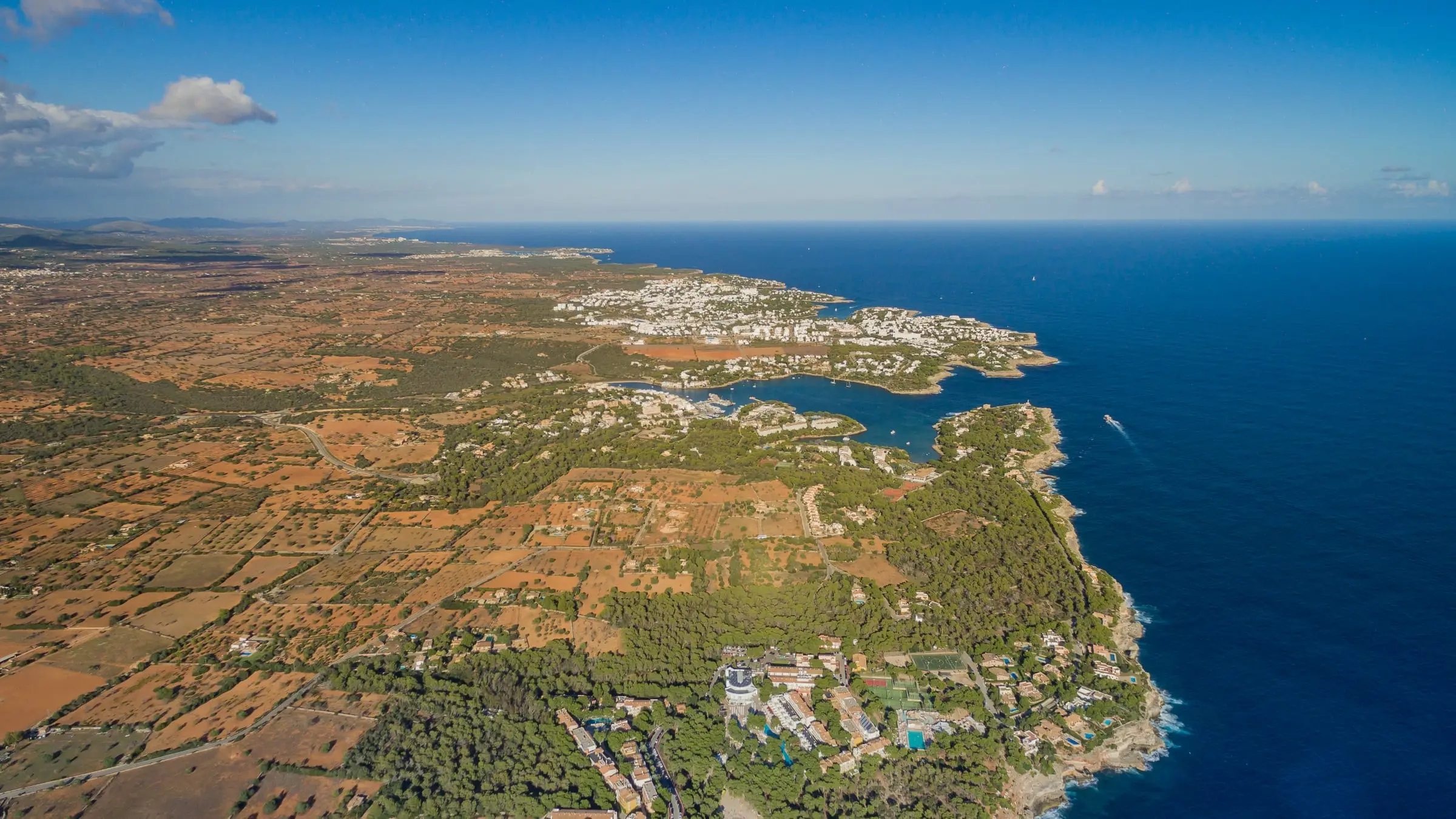
A town that looks like Ibiza because an Ibizan built it. White façades, flat roofs, nothing taller than the pines — not a styling decision of today but a building rule from 1932.
Source: INE, Padrón Continuo · 2026-08-04
Cala d’Or belongs to the municipality of Santanyí and lies on Mallorca’s south-east coast. The town spreads across several small coves that together carry its name.
In 1932 the Ibizan artist and architect Josep Costa Ferrer, known as Picarol, came to this coast and decided to build a settlement here modelled on the white villages of Ibiza. He renamed the cove of Cala d’Hort to Cala d’Or, brought in twelve co-founders — and set building rules that still govern the townscape: low construction, white façades, flat roofs, and nothing higher than the pines.
That is the real difference from the other resorts on the east coast. Cala d’Or has a coherent look because somebody gave it one over ninety years ago. No other town of this size on Mallorca has that history.
The coves are also the districts, and in daily life they differ clearly.
Cala Gran is central and has the largest beach in town — busy in proportion, with the shortest walk to everything.
Cala Esmeralda is a small cove whose pines reach almost to the water. The green of the water gave it its name.
Cala Ferrera is the family beach: pale sand, a shallow entry, lifeguards in season.
Cala Serena lies further east and is the quietest of the four. Together with Cala Ferrera it is the part where people are most likely to live year-round rather than only in summer.
Cala Egos and the old centre around Es Fortí make up the part that looks least like a holiday development.
The marina sits in Cala Llonga, the largest of the inlets, with 563 berths over some 30,000 square metres. It is one of the bigger harbours on the east coast and one reason the town has life outside the summer months.
The municipality of Santanyí had 12,321 registered inhabitants in 2022, against 13,095 in 2011. Over eleven years it has shrunk by 6 per cent.
The second series is the more interesting one. The registered foreign population stood at 4,697 in 2011 and today, at 3,380, is around 28 per cent below that. That is the mark of the financial crisis, and in Santanyí it has not been made up.
Both series come from the Spanish statistics office’s Padrón Continuo and record only people with a registered address. Second homes do not appear in them — and second homes are the greater part of what is bought on Mallorca. The figures describe the town, not the market. Read as a demand indicator, they mislead.
The 1932 rules cut two ways, and both matter.
One: the townscape is stable. What stands here will not be built over or overtopped — the low-rise character has shaped the stock for ninety years.
Two: alterations are not free. If you buy in Cala d’Or and want to change a façade, a roof form or a height, establish before the purchase what the Santanyí planning rules allow, not after. On a property needing renovation that is the most expensive thing you can overlook.
New ETV licences are not currently being issued on Mallorca. What matters is therefore not the location but whether the individual property carries an existing one. Every property of ours states it in the key facts.
Guide to the holiday rental licenceBuying on Mallorca rarely takes weeks. Tell us what you are looking for — we get in touch when something fitting comes up, and no more often than that.
Population figures are official, from the INE. Market observations are our own and are not statistics.