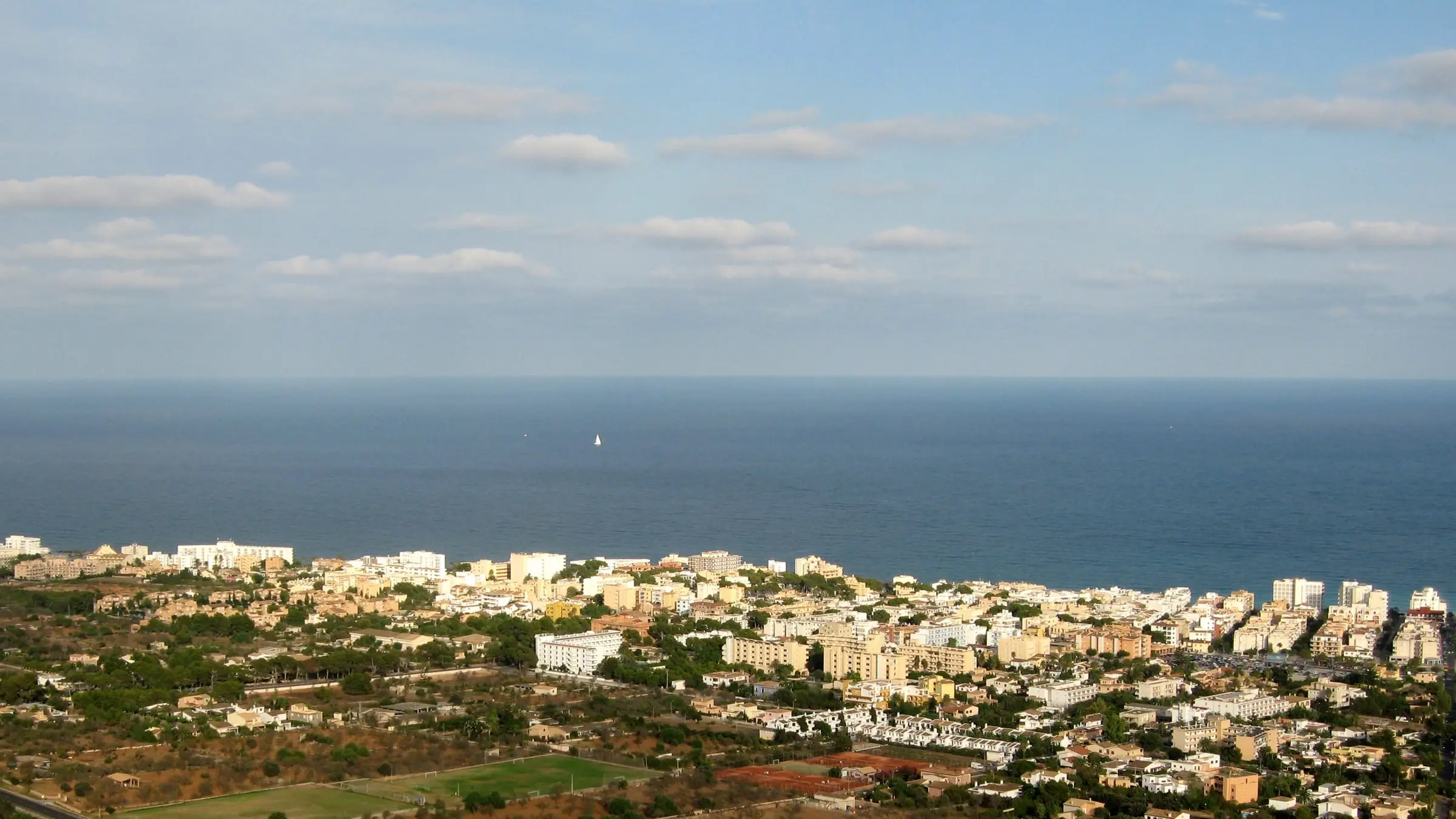
Nearly two kilometres of unbroken sand with a promenade in front of it. Cala Millor is where the otherwise rocky east coast turns flat — and the only town on this side that has grown across a municipal boundary.
Source: INE, Padrón Continuo · 2026-08-04
Cala Millor lies on Mallorca’s east coast and has a peculiarity you cannot see: the town straddles two municipalities. The northern part belongs to Son Servera, the southern to Sant Llorenç des Cardassar. The boundary runs through the built-up area.
For a buyer that is not a detail. Building rules, local taxes and which town hall handles permissions all depend on which side of the line a property sits. The figures below are for Son Servera.
The unbroken sand is the defining feature. Unlike the rock coast to the north and south, everything here shelves gently, and the promenade runs the full length. That makes the town easy to walk and good for families — and busy in proportion during summer.
Cala Millor is therefore the opposite of the cove principle that shapes the rest of the east coast. Where Cala d’Or or Cala Ratjada consist of several separate inlets, here it is all one line.
Cala Millor does not stand alone; it is the largest point in a chain of coastal settlements that run into one another. Anyone looking here should know all of them.
Cala Bona lies two kilometres north and was originally the fishing harbour for the area. Smaller, quieter, with a harbour basin instead of a beach promenade.
Costa dels Pins lies further north on the headland towards Cap des Pinar and is the quietest and most spaciously built part of this coast — villas among the pines rather than apartment blocks on the sand, plus a golf course.
Sa Coma and s’Illot adjoin to the south, already in the municipality of Sant Llorenç.
Son Servera also takes in the smaller harbour settlements of Port Verd, Port Nou and Port Vell. The municipal town of Son Servera itself lies a few kilometres inland — a grown Mallorcan village with little to do with the business of the coast.
The municipality of Son Servera had 11,752 registered inhabitants in 2022, against 12,195 in 2011. Over eleven years it has shrunk by 4 per cent.
The second series is the more interesting one. The registered foreign population stood at 3,365 in 2011 and today, at 2,074, is around 38 per cent below that. That is the mark of the financial crisis, and in Son Servera it has not been made up.
Both series come from the Spanish statistics office’s Padrón Continuo and record only people with a registered address. Second homes do not appear in them — and second homes are the greater part of what is bought on Mallorca. The figures describe the town, not the market. Read as a demand indicator, they mislead.
The fall in registered foreign population is the steepest of all the municipalities we checked for these pages. What it says about today’s market is limited — the series records residence registrations, not second homes. What it does show is how hard the east coast was hit from 2008.
The municipal boundary through the middle of town is the thing most often missed here. Two properties three hundred metres apart can fall under different building rules and different local charges. Settle that before the notary appointment, not after.
The second point is the season. Cala Millor depends on beach tourism more than the cove towns further north. If you want to know whether a place works year-round, visit in February, not July.
New ETV licences are not currently being issued on Mallorca. What matters is therefore not the location but whether the individual property carries an existing one. Every property of ours states it in the key facts.
Guide to the holiday rental licenceBuying on Mallorca rarely takes weeks. Tell us what you are looking for — we get in touch when something fitting comes up, and no more often than that.
Population figures are official, from the INE. Market observations are our own and are not statistics.