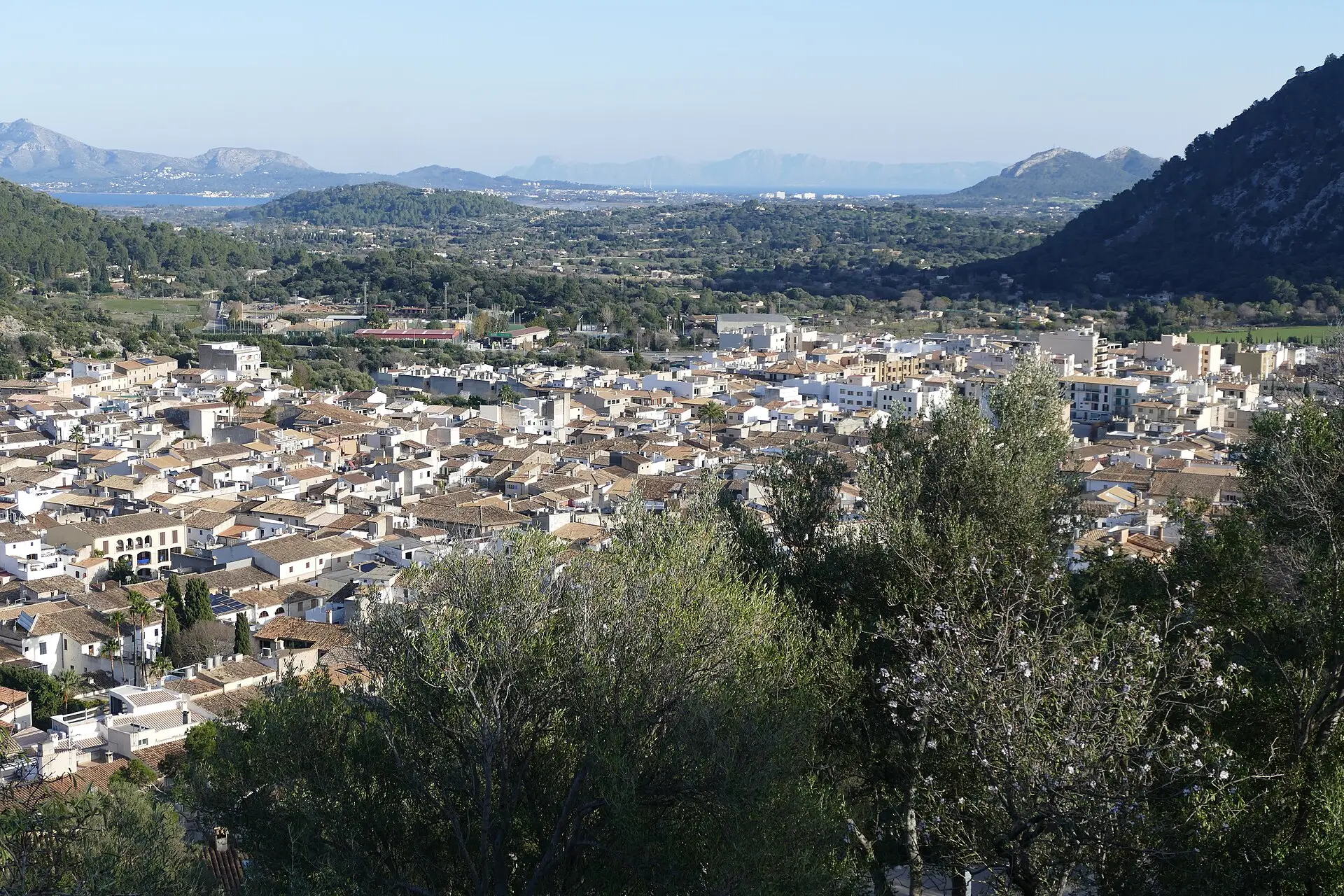
Six kilometres behind the harbour lies the town that gives it its name: limestone lanes around the Calvari steps, a Sunday market that gathers the whole region — and a property market searched for mostly in English.
Source: INE, Padrón Continuo · 2026-08-22
Pollensa and its port are two different places with two different markets — if you search for one and land at the other, you are searching wrongly. The port is the waterside residential town; the old town, six kilometres inland at the foot of the Tramuntana, is the municipality’s historic centre. This page is about the town; for the harbour, see Puerto Pollensa.
Two hills define the town’s image: Calvari, whose stairway of 365 steps climbs from the old town to the chapel above, and opposite it the Puig de Maria with its monastery. Between them lies the old town of limestone houses, grouped around the Plaça Major and its cafés. At the northern edge, the Pont Romà spans the torrent — a bridge of Roman origin that gives the town its depth in the literal sense.
The Sunday market gathers half the region, and in summer the Pollensa Festival has filled the monastery courtyard with concerts since the 1960s. The town has a long history as an artists’ place — you can see it in a density of galleries unusual for a town this size.
What trades in the old town are above all limestone townhouses — narrow in cut, with patios and roof terraces looking onto Calvari or the Puig de Maria. The stock is limited and coveted: Pollensa has had one of the island’s most loyal international buyer circles for decades, and the searching happens mostly in English.
In the countryside, in the valleys towards the Tramuntana, lie fincas in a landscape that belongs to the Serra’s UNESCO World Heritage — with the protection rules that brings: what may be changed on a house belongs before the purchase, not after it.
The municipality of Pollença had 17,126 registered residents in 2022, against 16,114 in 2011 — plus six percent. The registered foreign population rose from 3,534 to 4,003, a gain of 13 percent — above its pre-crisis level, which no other coastal municipality we examined has managed.
The figures come from the Padrón Continuo of the Spanish statistics office and count registered residents — second homes do not appear in them. What they do show: Pollensa is lived in year-round, and it is growing. A town people move to carries a different infrastructure from one that stands half empty for eight months a year.
The town is the rare case where “coveted” and “lived-in” coincide: international demand meeting a limited old-town stock, carried by a town that works in winter too. That keeps prices stable — and makes patience the most important currency of the search. Good townhouses here often change hands privately; a serious buyer should be known before the property is listed.
New ETV licences are not currently being issued on Mallorca. What matters is therefore not the location but whether the individual property carries an existing one. Every property of ours states it in the key facts.
Guide to the holiday rental licenceBuying on Mallorca rarely takes weeks. Tell us what you are looking for — we get in touch when something fitting comes up, and no more often than that.
Population figures are official, from the INE. Market observations are our own and are not statistics.