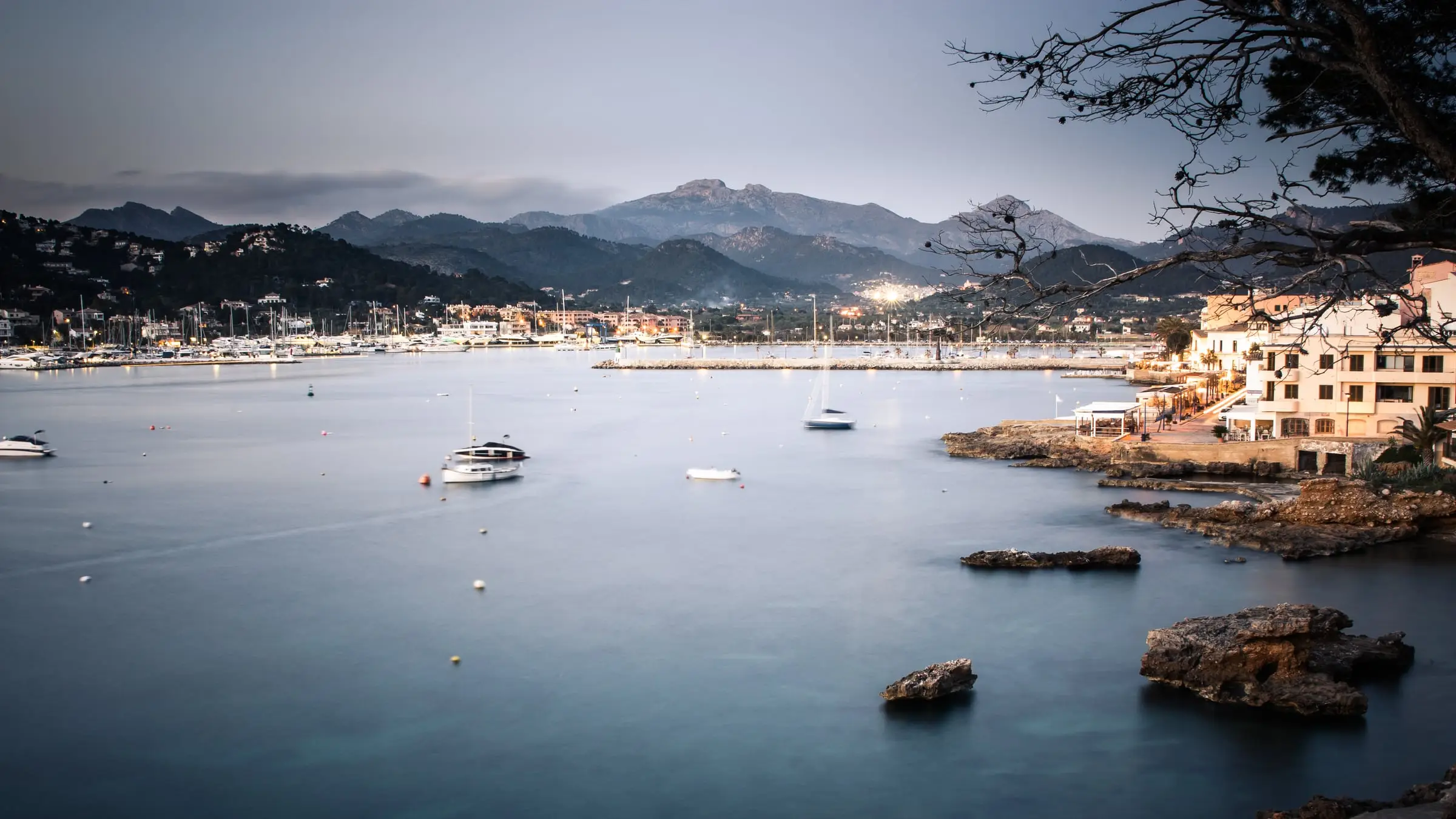
A natural harbour whose slopes were built on without the shape of the harbour being lost. Because the inlet is narrow, the houses stack above one another rather than behind — and almost every position sees water.
Source: INE, Padrón Continuo · 2026-08-04
Port d’Andratx lies at the south-western end of Mallorca, municipality of Andratx. The harbour is a natural inlet cut deep into the coast; the town climbs the slopes on both sides.
Five kilometres inland lies Andratx itself, the grown municipal town with its weekly market and art centre. As in Pollença, harbour and town are two different worlds with two different markets.
The narrowness of the basin is the reason for the town’s character. Because the slopes fall steeply to the water, the building steps in terraces — each level sits above the one in front, and the view passes over a neighbour’s roof to the water rather than into their windows.
That is the structural heart of the place: sea view and privacy are not in conflict here, despite the density. On a flat coast the same density would be unbearable.
La Mola occupies the westernmost point, raised above the harbour mouth. The most exposed position in town, looking over the whole basin and out to open sea.
Cala Llamp lies to the south-west, slightly elevated and still close to the centre — villas and houses with a wide outlook without a long drive.
Cala Moragues is the quieter version: a small cove with apartments and villas, away from the harbour traffic.
Montport and Cala Marmacén sit on the slopes above and between.
At the water itself, around the basin, is the centre with its promenade, restaurants and the fishing harbour — which is still a working one, alongside the yacht berths.
To the north the Serra de Tramuntana begins immediately, a UNESCO World Heritage site since 2011. The coast road to Estellencs and Banyalbufar is one of the best-known drives on the island. To the west lies Sant Elm, looking across to the island of Sa Dragonera, a nature park.
Palma is a little over half an hour away, the airport just under forty minutes.
The municipality of Andratx had 11,735 registered inhabitants in 2022, against 11,919 in 2011. Over eleven years it has shrunk by 2 per cent.
The second series is the more interesting one. The registered foreign population stood at 4,178 in 2011 and today, at 3,012, is around 28 per cent below that. That is the mark of the financial crisis, and in Andratx it has not been made up.
Both series come from the Spanish statistics office’s Padrón Continuo and record only people with a registered address. Second homes do not appear in them — and second homes are the greater part of what is bought on Mallorca. The figures describe the town, not the market. Read as a demand indicator, they mislead.
The slope is both the advantage and the cost. It delivers the view, but it makes everything dearer: access, foundations, terracing, the upkeep of retaining walls. On older hillside properties, retaining walls and drainage are where a survey pays for itself soonest.
The second point concerns the Tramuntana. A substantial part of the Andratx municipal area falls within protected zones. What is possible there depends not on plot size but on protection category — and that does not appear in the listing.
New ETV licences are not currently being issued on Mallorca. What matters is therefore not the location but whether the individual property carries an existing one. Every property of ours states it in the key facts.
Guide to the holiday rental licenceBuying on Mallorca rarely takes weeks. Tell us what you are looking for — we get in touch when something fitting comes up, and no more often than that.
Population figures are official, from the INE. Market observations are our own and are not statistics.