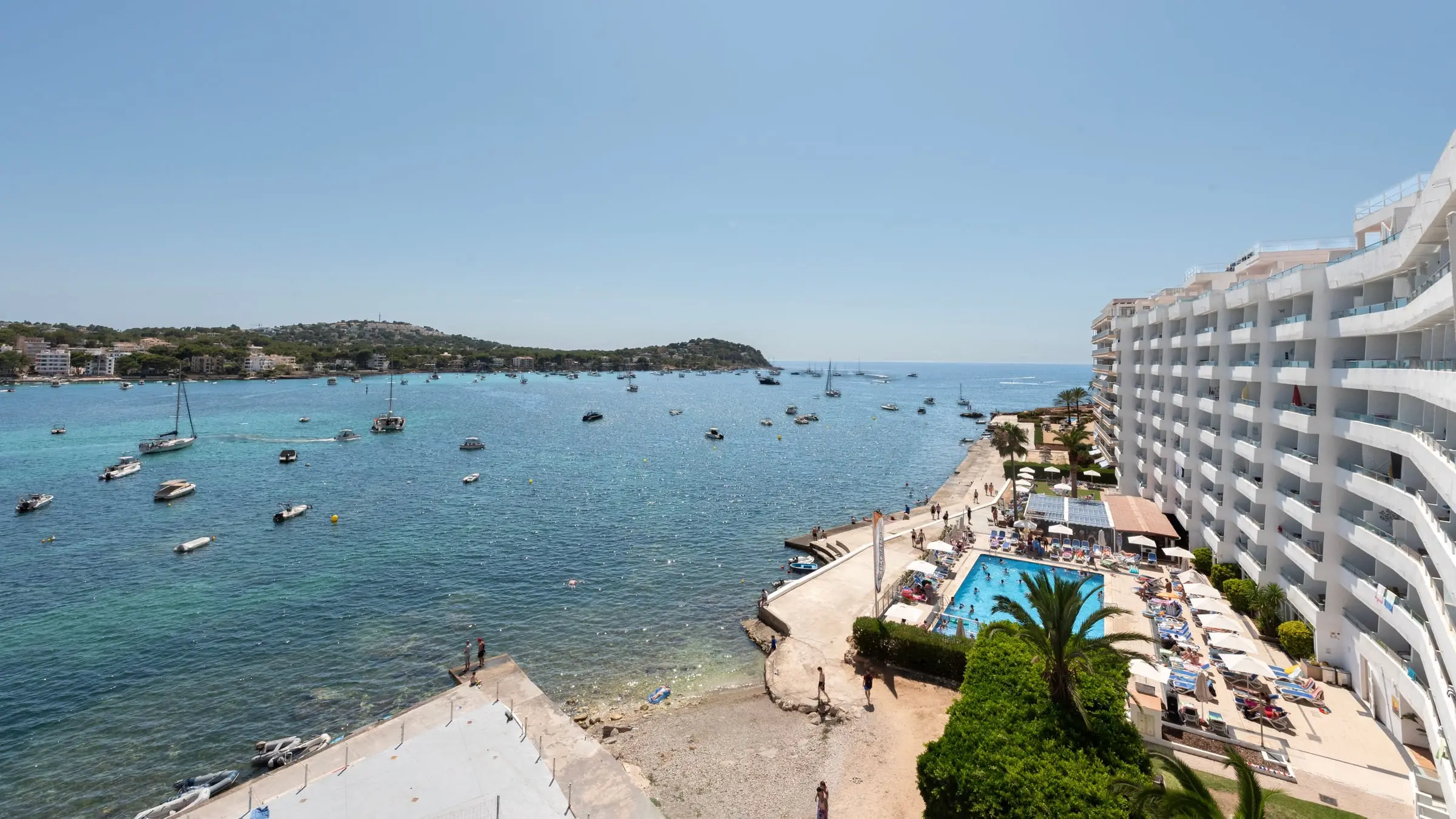
One of the few places on Mallorca that was planned as a resort rather than grown over centuries. It shows — and for a certain kind of buyer that is precisely the advantage.
Source: INE, Padrón Continuo · 2026-08-04
Santa Ponsa lies in the south-west of Mallorca, municipality of Calvià, about twenty kilometres from Palma and under thirty from the airport. The town has grown as a holiday resort since the 1960s.
On 10 September 1229 Jaume I landed with his fleet on this coast and began the conquest of Mallorca from here. The landing was in fact meant for the bay of Pollença; a strong mistral pushed the fleet south. At Sa Caleta stands the Creu del Desembarc, the cross of the landing, put up in 1929 for the seven-hundredth anniversary.
That is not a footnote for tourists. It is why a town otherwise almost entirely of the twentieth century has a historical anchor no other resort on the island can claim.
Buying here means choosing between several urbanisations that have grown together but keep distinct characters.
Santa Ponsa itself, around the bay and the beach, is the core with the densest infrastructure: shops, restaurants, promenade, open all year.
Nova Santa Ponsa lies between Santa Ponsa and El Toro and covers the newer urbanisations around the golf courses. Larger plots, younger stock, less bustle, more driving.
Costa de la Calma adjoins to the west — the “coast of calm”, and the name describes the difference from the centre well enough.
El Toro sits to the south, above Port Adriano. The marina was designed by Philippe Starck and is the reference point for this stretch of coast in the way the beach is for the centre.
The street layout is generous, the plots usually are too, and the infrastructure is built for a season. If you want a grown Mallorcan town centre, Santa Ponsa is the wrong place — there isn’t one, and there never was.
If instead you want golf courses, two marinas, international schools and twenty minutes to Palma, Calvià offers that combination more densely than anywhere else on the island. That is the real property of the place: it is well connected, and it is close to everything.
The municipality of Calvià had 52,458 registered inhabitants in 2022, against 52,451 in 2011. Over eleven years it has stayed effectively flat.
The second series is the more interesting one. The registered foreign population stood at 19,233 in 2011 and today, at 16,950, is around 12 per cent below that. That is the mark of the financial crisis, and in Calvià it has not been made up.
Both series come from the Spanish statistics office’s Padrón Continuo and record only people with a registered address. Second homes do not appear in them — and second homes are the greater part of what is bought on Mallorca. The figures describe the town, not the market. Read as a demand indicator, they mislead.
The scale is worth noting: Calvià is by far the largest of the municipalities we checked for these pages — more than four times the size of Capdepera or Andratx. And at close to a third, it has the highest share of foreign residents of any of them. Santa Ponsa is not a Mallorcan town with international second homes. It is an international town on Mallorca.
Proximity to Palma is the hard advantage and it shows up everywhere: in the run from the airport, in year-round supply, in whether you need a car at all.
The price is density. More has been built in the south-west than on the east or north coast, and building continues where conservation rules capped it long ago elsewhere. If you want a view and quiet secured for the long term, Calvià is where you have to look carefully at what can still go up beside and in front of a plot.
New ETV licences are not currently being issued on Mallorca. What matters is therefore not the location but whether the individual property carries an existing one. Every property of ours states it in the key facts.
Guide to the holiday rental licenceBuying on Mallorca rarely takes weeks. Tell us what you are looking for — we get in touch when something fitting comes up, and no more often than that.
Population figures are official, from the INE. Market observations are our own and are not statistics.